FABULA now exists for the Amiga too. The idea is the same as on the C64: an engine and a workshop for building your own point-and-click adventures. The engine, though, is new, written from scratch for the Amiga 1200 with its AGA chipset. The concept came across, not the code.
The look is modelled on the VGA versions of Monkey Island 2 and Indiana Jones 4: 256 colours instead of the 32 of the Amiga ports back then. The workshop runs on modern computers, the finished game on the A1200 – as a build for AmigaOS and one for WHDLoad, tested in an emulator and, since 6 September, on real hardware as well: a Vampire V4 Standalone.
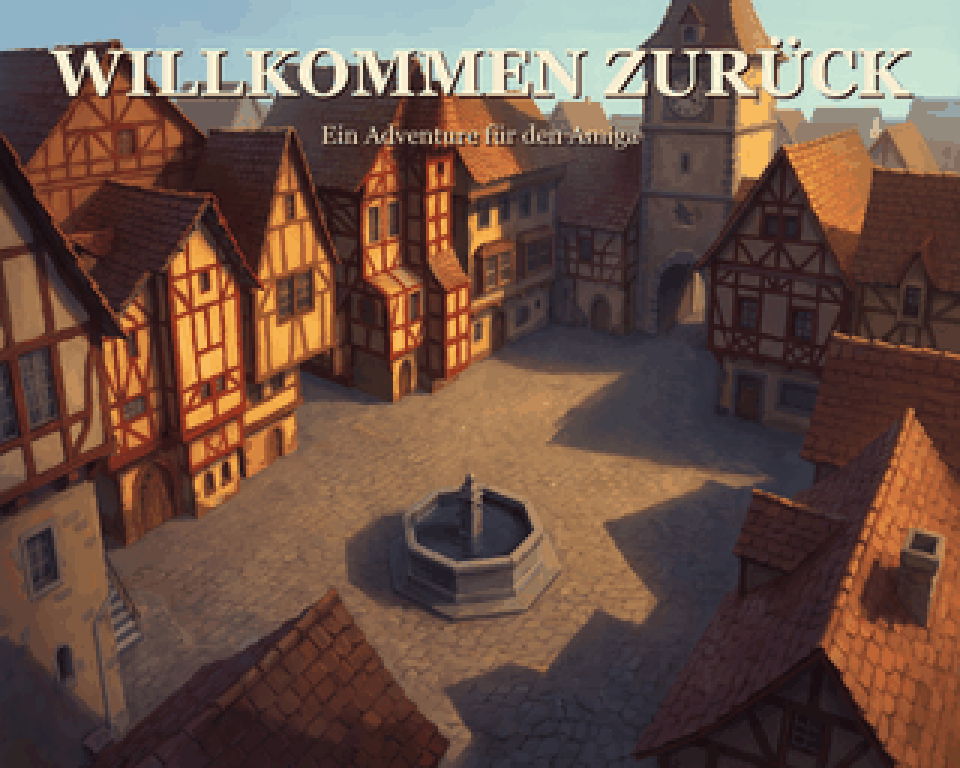
NewThe title screen of the example game. 256 colours, AGA – pixel-exact from the emulator.
Status: in development◆Target: Amiga 1200 · AGA · 256 colours◆8 of 9 milestones◆Started 4 September 2026
Status / 15 September 2026
In the middle of development.
1> FABULA
The Amiga version is in development, and there is no release date. It is at a much earlier stage than the C64 FABULA: work began on 4 September 2026. Eight of nine milestones are reached; the last one, the example game, is still open.
Testing happens on an emulated Amiga 1200 and on a Vampire V4 Standalone. The V4SA is far faster than an A1200, so it is no yardstick for speed or loading times. It answers a different question: does it run on real hardware? Figures for frame rate and loading time come from the emulator. The target machine is an Amiga 1200 with a 68020 and AGA, PAL, at least 2 MB of chip RAM; the development target is 2 MB chip RAM plus 8 MB fast RAM.
M0
Toolchain and test loop
One command builds the program and starts it in the emulator, and an AGA picture with 256 colours appears.
Reached · 4 Sep
M1
Room display
A room picture converted from PNG, two drawing buffers, and only what has changed gets redrawn. Animated patches and scrolling wide rooms followed on 6 September.
Reached · 4 Sep
M2
Figure
Walk areas, pathfinding, walk cycle, facing direction, depth sorting and size by depth.
Reached · 4 Sep
M3
Controls
Mouse pointer, hotspots, sentence line, verb bar and an inventory modelled on Monkey Island 2.
Reached · 5 Sep
M4
Script machine
Game data format, interpreter, room changes with loading, timers, speech text and the pre-build check. All 18 commands of this milestone were verified on screen.
Reached · 5 Sep
M5
Storytelling
Conversations, cutscenes, full-screen pictures, animation sequences, end credits and saved games, verified under AmigaOS and under WHDLoad.
Reached · 6 Sep
M6
Sound
Music as modules and sound effects as samples, both measured under AmigaOS and WHDLoad.
Reached · 6 Sep
M7
Workshop
Project file, room view, script editor, paint editor with layers, checking and running. It has kept growing since.
Reached · 6 Sep
M8
Example game
A game that uses everything and can really be played. SENDESCHLUSS from the C64 ran all the way through for the first time on 9 September and was played through by hand on the V4SA on 10 September. WILLKOMMEN ZURÜCK has had all four acts on the Amiga since 10 September.
In progress
Pictures / Work in progress
What it looks like.
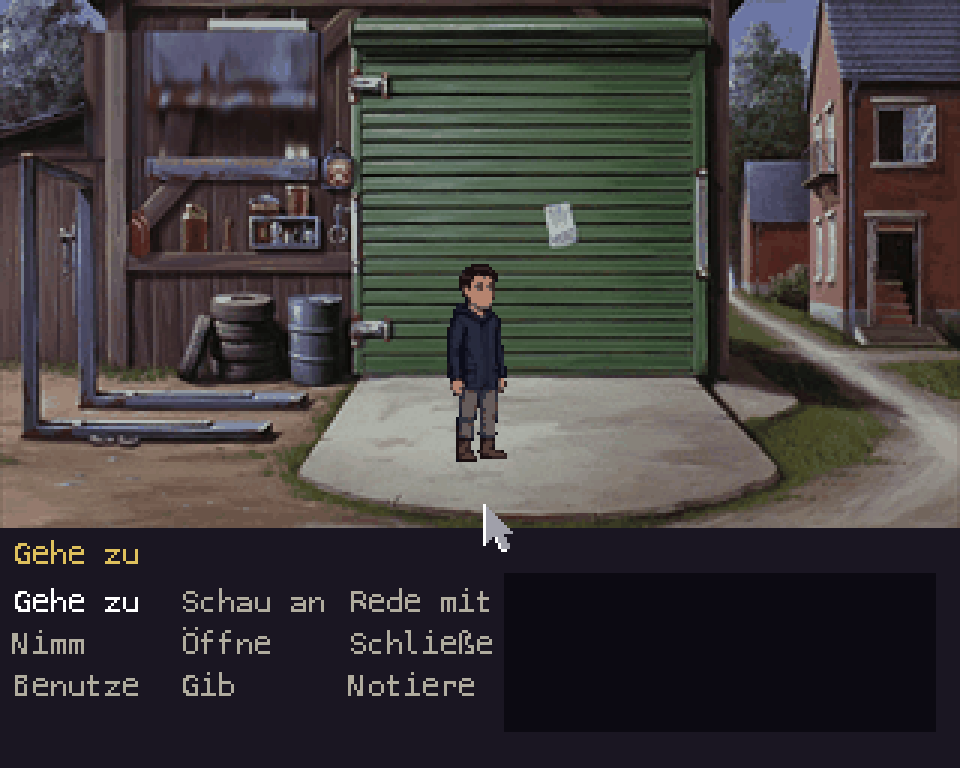
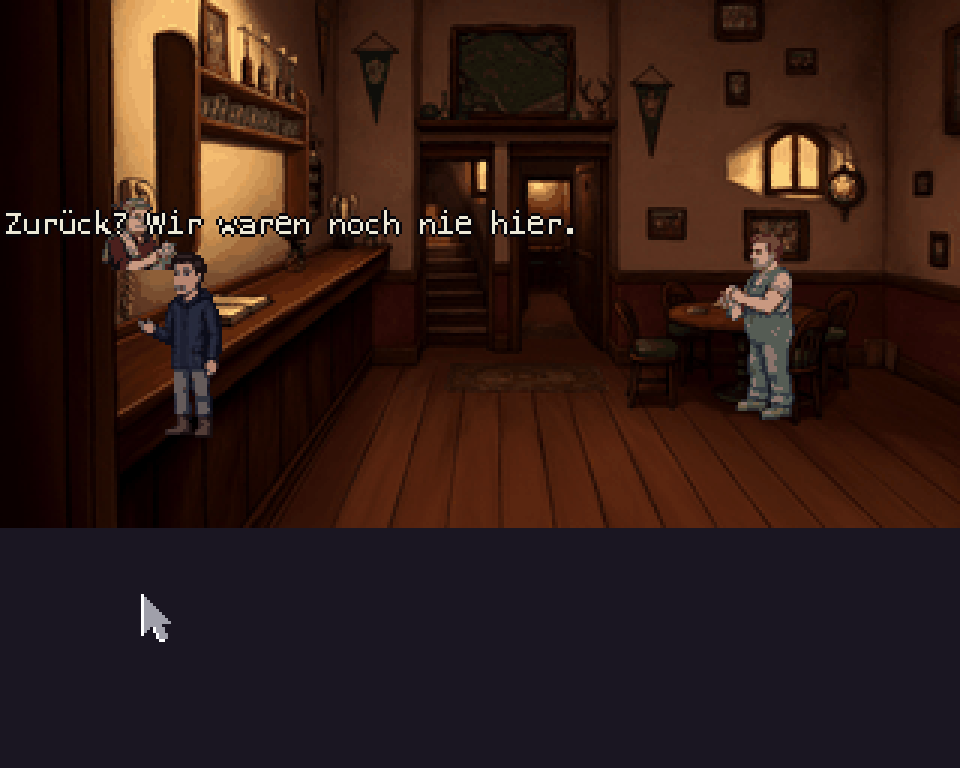
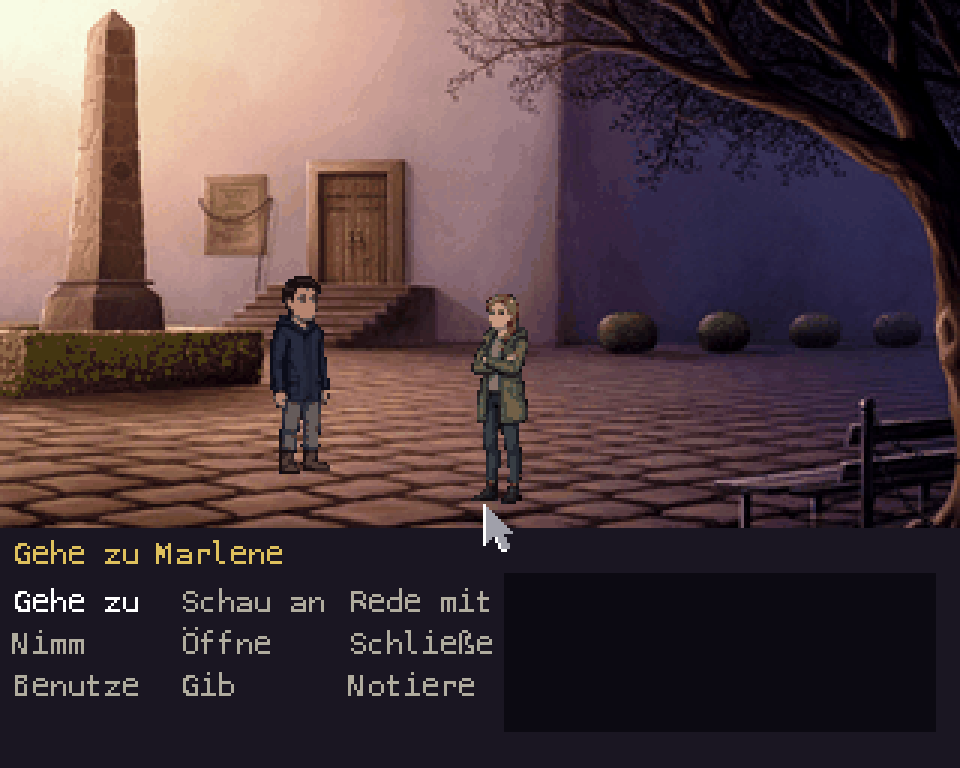
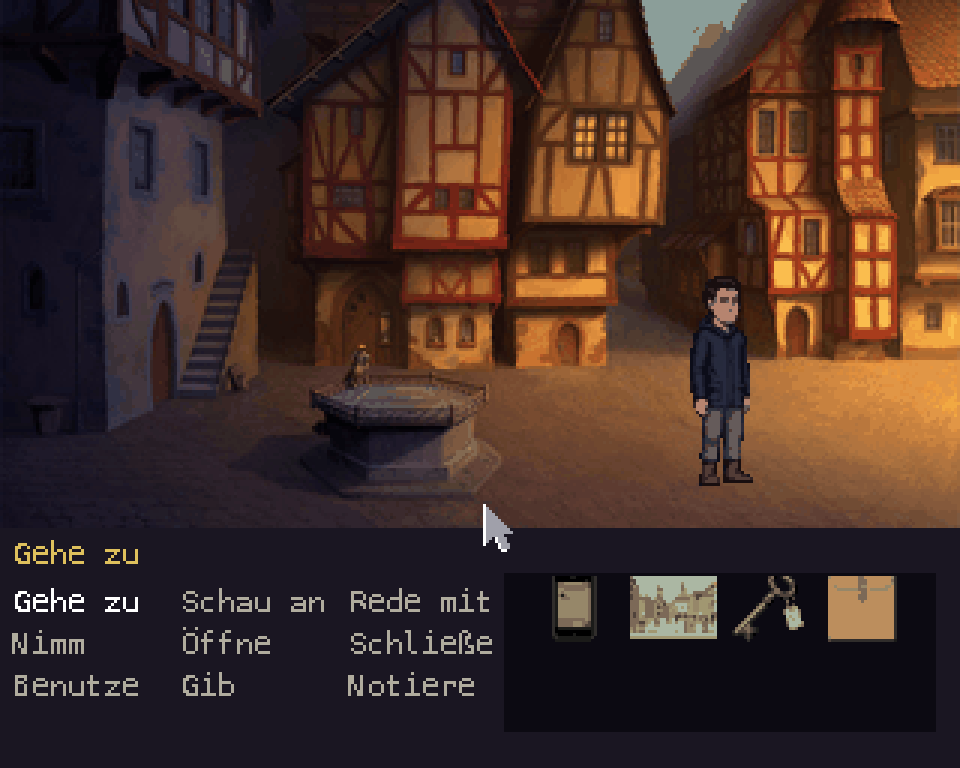
The Amiga version's test bed is WILLKOMMEN ZURÜCK: an inheritance, a postcard from a small town you have never been to, and a diversion at dusk. All four acts are built and have been played from start to finish in the emulator, with 27 rooms and around 900 texts in German and English. It is also being playtested on the V4SA.
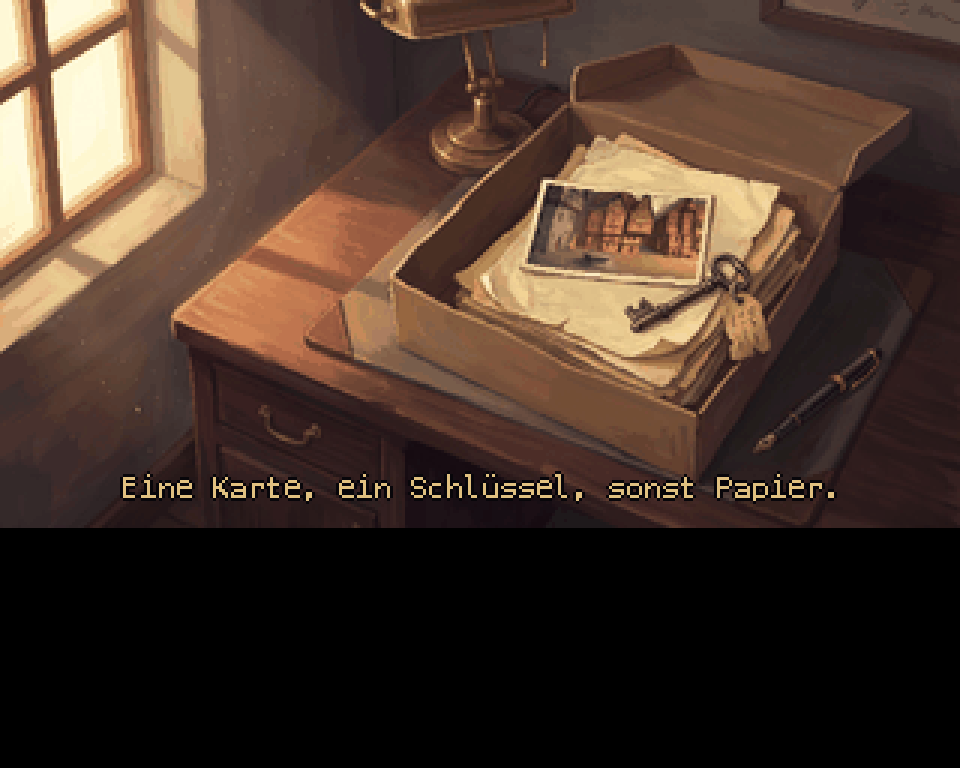
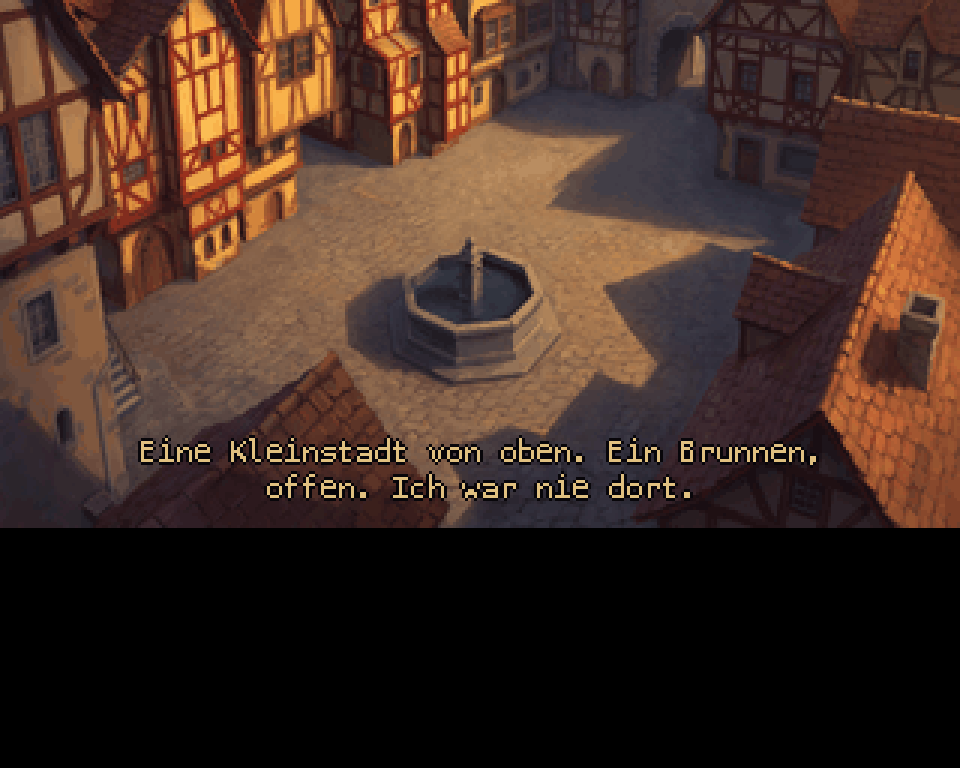
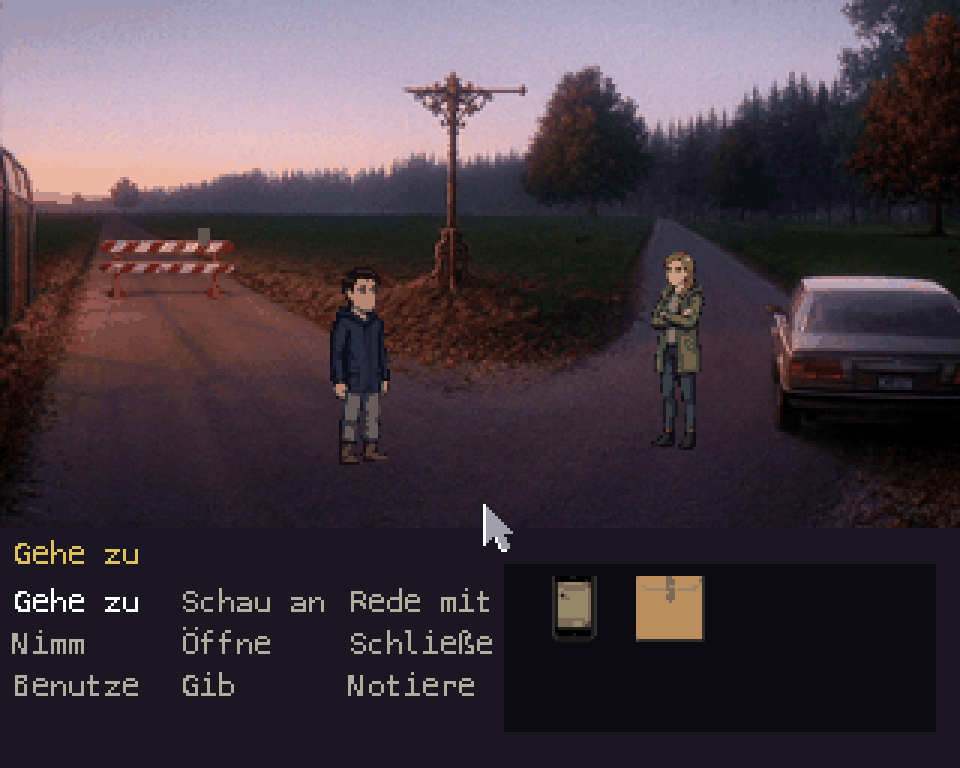
The intro: a postcard, a key, and the rest is paperwork.A postcard from a small town you have never been to.The diversion at dusk. Verbs below, inventory on the right.The garage yard.Inside the Zum Adler inn.The church square with its monument.The market square, with the items from the intro in the inventory.
From the workshop
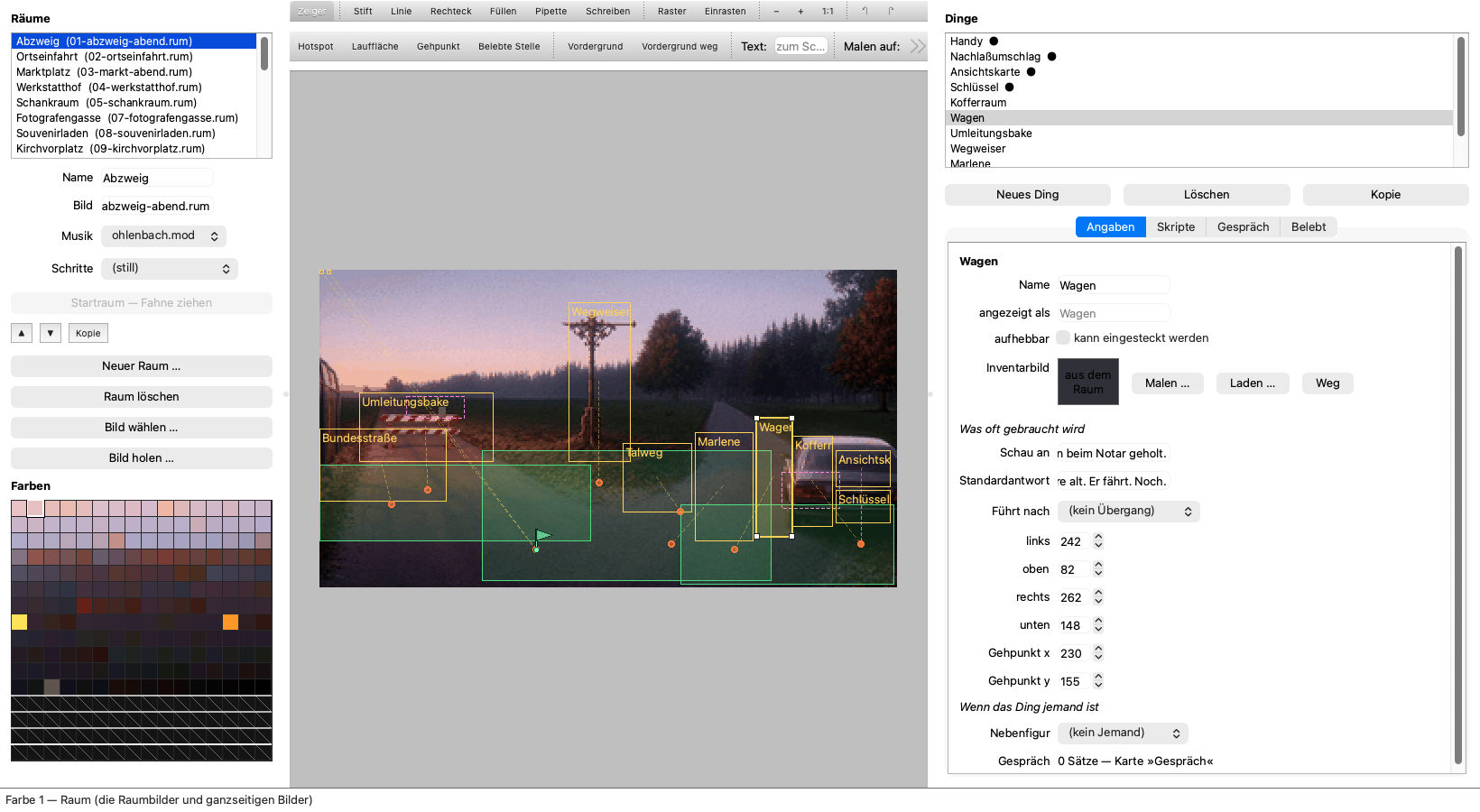
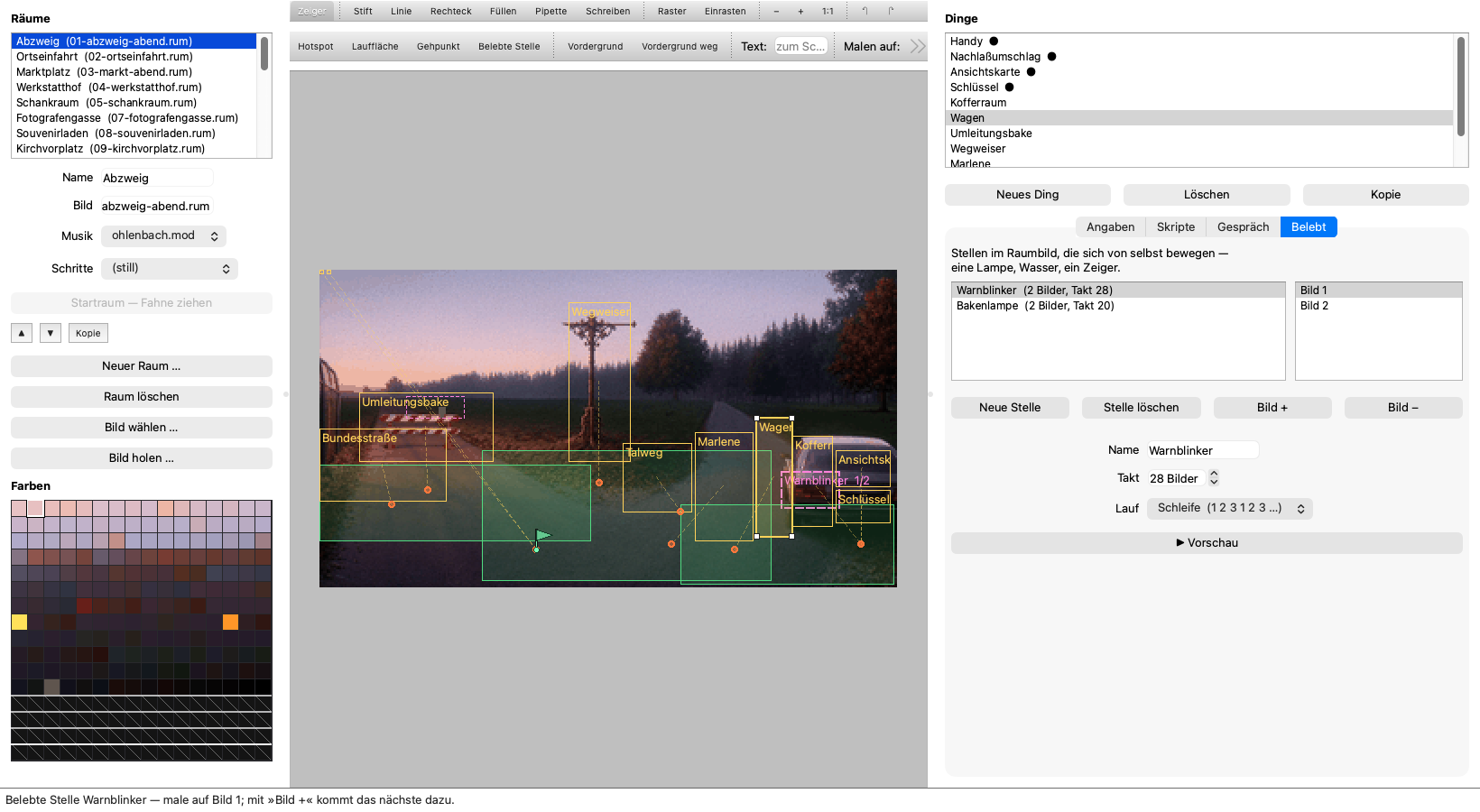
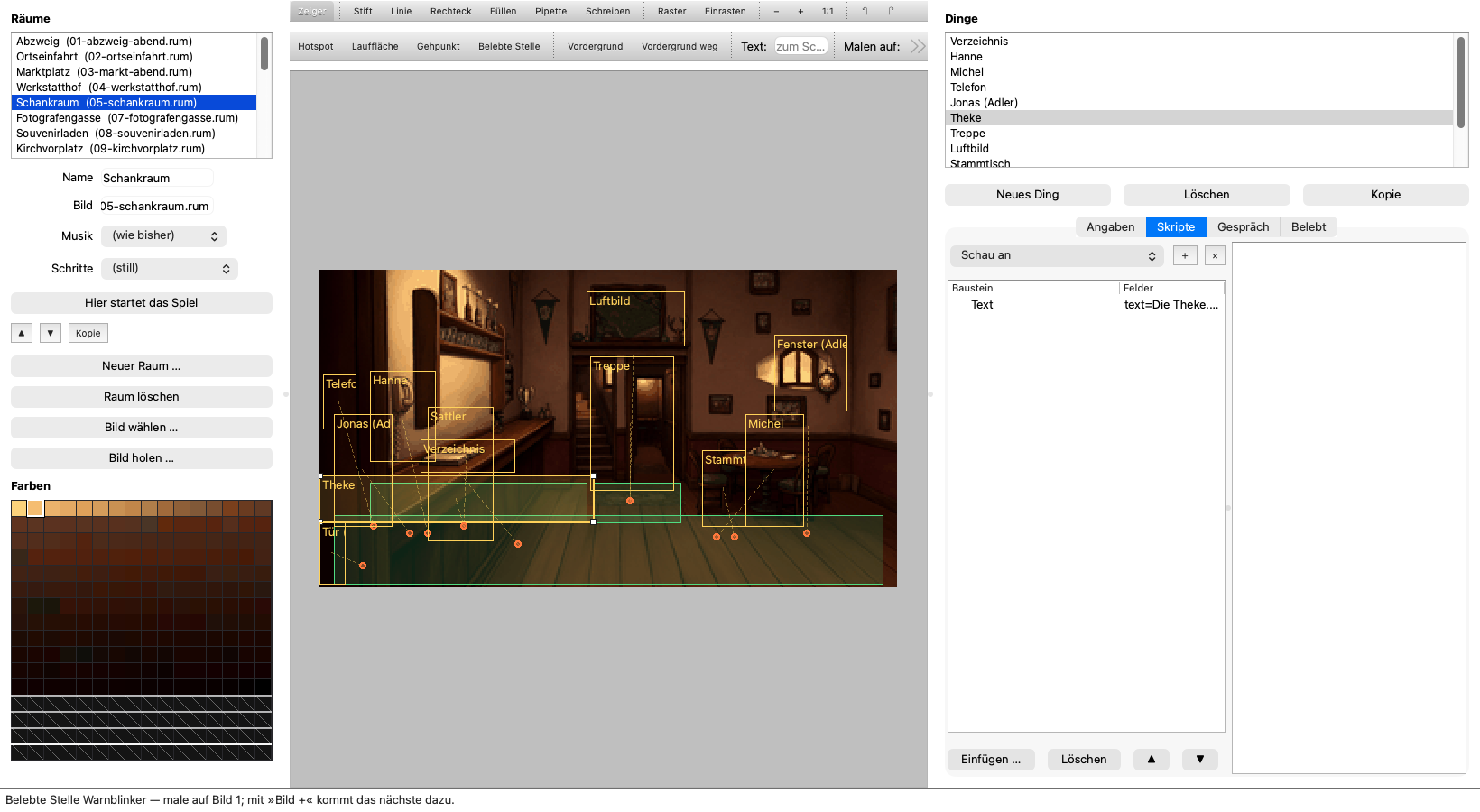
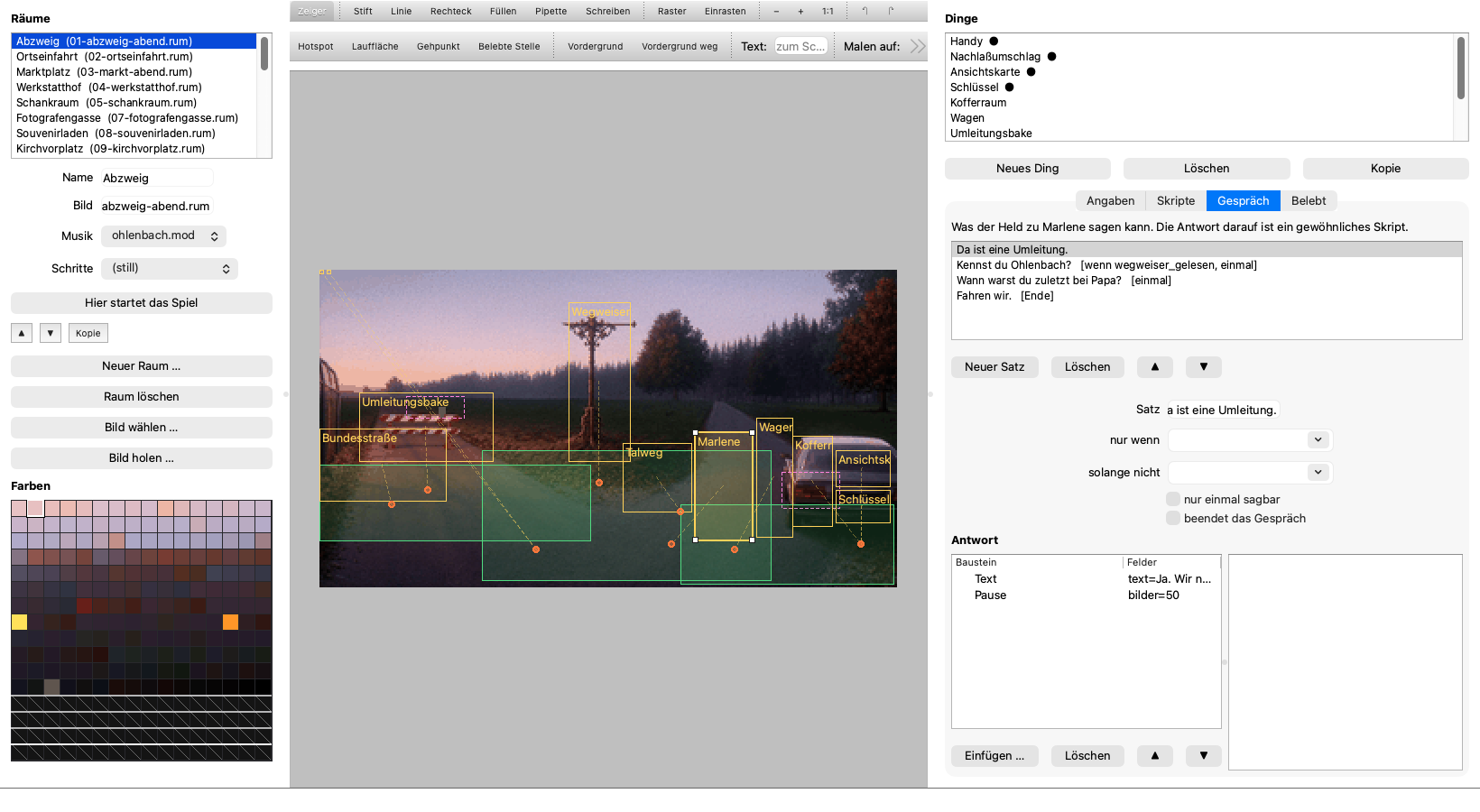
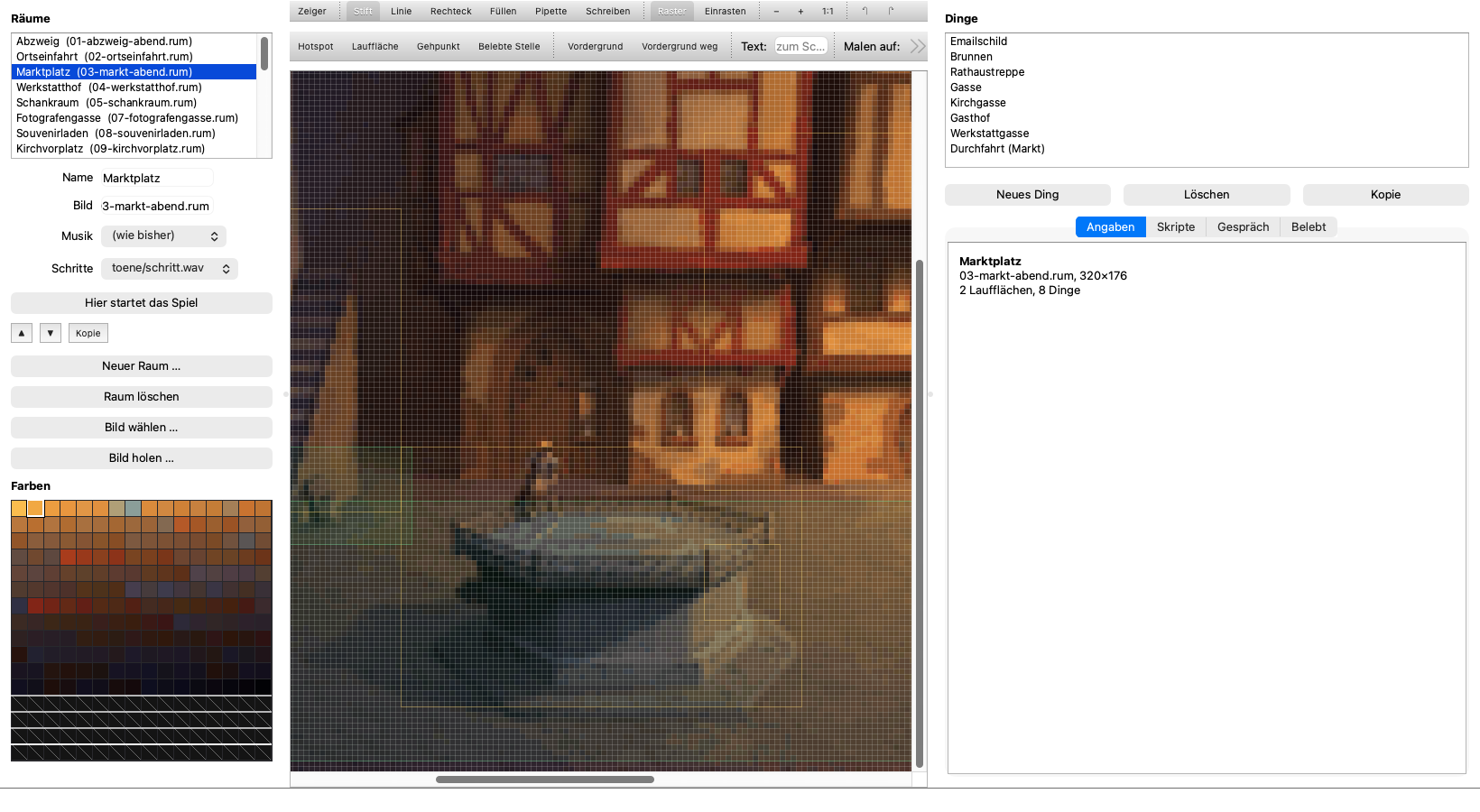
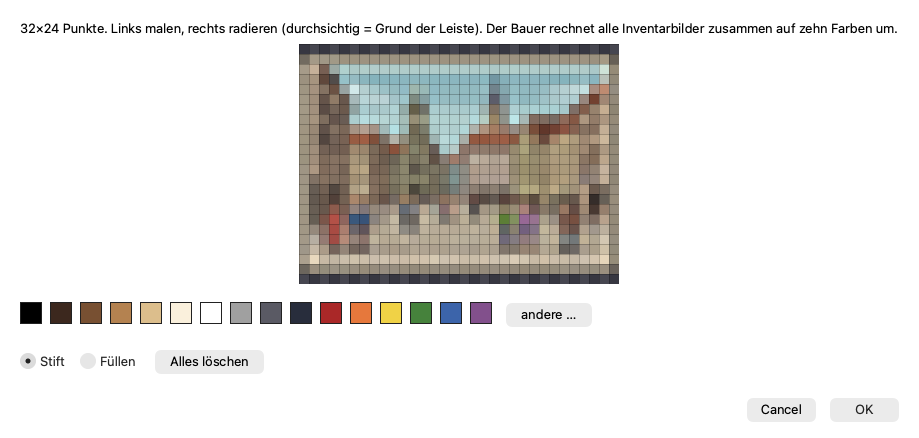
Room, hotspots, walk areas and walk-to points, all dragged out on the picture.Animated patches: the hazard light, painted frame by frame, previewed at the engine's tempo.Scripts from building blocks, no programming.Conversations: lines with conditions, every answer a script.The built-in paint editor: 256 colours, with a pixel grid.Every inventory picture is drawn on its own, 32 × 24.
All game pictures are pixel-exact from the emulator (A1200, AGA), enlarged three times; the workshop pictures are rendered from the window. They show only the opening and the intro, no spoilers. This is work in progress – a lot can still change before release.
Engine & workshop / Features
An adventure construction kit for the Amiga
The state of 15 September 2026. The Amiga version is in development; individual parts may still change before release.
01
On the Amiga 1200
The Engine
256 colours on AGA. The room is 320 × 176 pixels in eight bitplanes, with its own palette per room. 192 colours belong to the room picture, the rest to the figures, the bar and the mouse pointer.
Controls as in Monkey Island 2: nine verbs, a sentence line and a picture inventory in the bar below the room.
The right mouse button does the obvious thing: Talk to for people, Open for doors, Pick up for anything that can be taken, otherwise Look at. The figure walks there first and then acts.
Blitter figures, masked and placed pixel-exact, with walk areas, pathfinding and depth sorting. A room holds the hero and up to four other characters.
Depth per room. Each room sets how tall a figure is at the front and at the back.
Wide rooms scroll smoothly, pixel by pixel, in hardware.
Walking behind things: a foreground mask decides pixel by pixel what hides a figure.
Animated patches and layers. Up to eight animated patches per room with up to 16 frames each. Pick something up and the painted spot underneath appears, and a lid you closed is still closed when you come back.
A script machine after FABULA/C64. All commands of the C64 engine under the same numbers, plus three of its own. Jumps only go forward, so no script can hang.
Conversations with up to six selectable lines, conditions and “only once”. The answer is an ordinary script.
Storytelling: cutscenes, full-screen pictures and pictures over the room, animation sequences, a title screen and scrolling end credits. A line stays on screen as long as it takes to read, and a click cuts it short.
Music and sound effects: ProTracker modules and samples. Long music recordings stream from fast RAM.
A menu at the top edge of the screen with Save, Load, Sound and Quit, plus F5 and F7. Four save slots, and each checks on loading that it belongs to this game.
Several languages in one game file, up to four, switchable in the menu.
A game is one file. Rooms are loaded packed during play, with a checksum per block. On an emulated A1200 a room change takes 180 to 260 milliseconds the first time; the frame rate is around 50 frames per second.
Two builds, one game file: start it with a double-click from the Workbench, or through WHDLoad. On quitting, the game hands the machine back cleanly.
10
On modern computers
The Workshop
Runs on modern computers, not on the Amiga. It builds the game and starts it in the emulator at the press of a key. The interface and the manual are available in German and English.
One canvas for everything: hotspots, walk areas, walk-to points, the start flag and the arrival markers of doors are dragged out on the picture, not typed in as numbers.
A built-in paint editor with 256 colours. You paint on colour numbers, so you see exactly the colours the Amiga will show – with pencil, line, rectangle, fill, colour picker and a pixel grid.
Importing pictures: PNG, IFF and other formats are converted into a room picture, with a preview of the result.
Layers for objects you pick up, and for flaps, lids and doors that open and close.
Animated patches are painted frame by frame and previewed at the engine's tempo.
Depth and foreground. Two measuring figures show how tall a figure gets at the front and back of the room; the foreground brush paints what hides it.
Scripts from building blocks. Nothing to type, so no forgotten bracket.
Conversation editor: lines with “only if”, “as long as not”, “can be said only once” and “ends the conversation”, with the answer below as a script.
Dedicated painters for inventory pictures (32 × 24 pixels), the mouse pointer, the font and the figures.
Music and sound: MOD modules, with XM converted on import, and sound effects as WAV. Music and footsteps per room, the door sound on the object.
Checking before building finds hidden hotspots, walk areas without a connection, arrivals inside a wall, flags that are only read or only set, texts that are too long and the engine's limits.
Languages and engine texts: one window shows every text of the game next to its translation and counts what is missing.
One undo stack for everything, with the manual and the key list built into the window.
Workshop log / Amiga
Lately in the workshop.
LOG.
AmigaEngine
Music from fast RAM, without dropouts
During playtesting on the Vampire V4SA, the music in the intro broke off with every picture and then took seconds to come back. The cause was the loading pause. While data is being read, the engine hands the hardware back to the operating system, and in doing so it also switched off Paula's sound channels. They only came back on with the next note. With a recording played in sections of 7.68 seconds, that can take up to eight seconds. Now the sound channels keep running through every pause.
That raised a second question: why keep everything in chip RAM? Until now the whole piece of music sat there, 723 KB for 69 seconds. A recording in sections does not need that. It now lives entirely in fast RAM, and chip RAM holds just two buffers of 80 KB each. Paula plays one while the other is already queued and gets picked up seamlessly on the next pass. The engine then fills the freed buffer with the next section. The music plays centred on two channels, which leaves two free for sound effects. Such a piece is recognised from the module itself, so the workshop needs no switch for it. One last stutter during cutscenes came from the master switch for all DMA channels, which the pause briefly turned off as well. It now stays on.
AmigaWorkshop
A line stays as long as it takes to read
On the V4SA the texts ran by too fast. Measured in the script, almost every line was followed by a pause of just over a second. The engine would have kept the line up longer, but by then the next one had already arrived. That is not a mistake in one script. It is simply the easiest way to write one, and it would happen again in every game.
So the rule FABULA found on the C64 now applies here too: at most eight seconds for a full line of 76 characters, shorter lines in proportion, and never less than 1.8 seconds. The build lengthens a pause that is too short after a line on its own, and the engine keeps the text on screen just as long. Because the workshop goes through the same build, this holds for every game without anyone touching a number. A click still cuts any pause short.
AmigaEngine
Verbs on the inventory
When tested on the V4SA, “Look at postcard” only highlighted the postcard, and nothing else happened. A click in the inventory put the item in your hand, whatever the verb. The items' scripts were there, but nothing could reach them. It now works as in Monkey Island 2 and Indiana Jones 4. If an item has a script of its own for the verb, or the verb only needs one object, it runs at once. With “Use” or “Give” the item goes into your hand and waits for the second object. Clicking the same item again puts it away, and the right mouse button on an item means “Look at”.
In the same test a car boot could be opened without anyone being able to see that it was open. The engine lacked two things. A closed state was not painted again when you re-entered the room. And an object coming back into the picture brought its original image with it, including everything that had long since been pocketed. Now, when an object reappears, the layers of the other objects that are gone or changed are repainted over it in their proper order. That holds for any object lying on top of another.
AmigaEngine
The picture decides how tall a figure is
At the edge of town the player character was taller than the town gate. How tall a figure gets at the front and back of a room used to be one setting for every room: 70 pixels at the front, 58 at the back. But a room painted from close up needs tall figures and a wide shot needs small ones. How tall a person appears is a property of the picture.
Now every room has its own depth: a front and a back floor row, each with the figure's height there, and the engine divides the space in between. The workshop shows two measuring figures in the picture for this, because you can only tell whether a person fits through the gate by looking at a person. The blitter does not scale, so the engine picks from the figure's ready-made size steps, and a room painted far away needs smaller steps. Older game files still work. A room without its own depth looks exactly as before: photographed in the emulator before and after the change, not a single pixel differs.
An engine in 6502 assembly, a workshop for Linux, macOS and Windows, and SENDESCHLUSS as a finished, free example game. The engine and workshop are due on itch.io in late autumn.